
Gilmer County Court Records After Arrest
A jail arrest creates a custody record first. In Gilmer County, that record may show the arrest date and time, arresting officer, total bond, warrant number, statute, charge description, offense type, court, sentence tab data, and release date when available. Those details are useful, but they are not the same as the court record that follows the arrest.
The court record begins when the prosecutor or court files the charging document and the case is opened or continued in the proper court. Felony Superior Court matters are handled through the Appalachian Judicial Circuit District Attorney and the Superior Court clerk. Lower-level charges may start in Magistrate, municipal, probate, or traffic contexts. The Gilmer County jail inmate records page is the custody path, while booking-photo questions belong with Gilmer County jail mugshots.
Search Gilmer Court Records After Arrest
Remote access starts with the Georgia Courts E-Access directory. The directory lists Gilmer Superior and routes users to PeachCourt. Georgia Courts states that users are redirected to the provider website and must have an account to search court records. That means the statewide judicial page is a gateway, not a free no-account Gilmer criminal docket.
- Search the jail roster first for the arrest date, court field, warrant number, statute, charge text, and bond clues.
- Open Georgia Courts E-Access and choose the Gilmer Superior listing if the case appears to belong in Superior Court.
- Use the provider account path for remote access, or contact the clerk if online access does not fit the case.
- Read the court charge list separately from the jail charge list because prosecutors may amend, reduce, add, or dismiss charges.
- For older or non-online files, ask the proper custodian for court-copy procedures.
The official clerk page identifies Amy E. Johnson as Superior and Juvenile Court Clerk and Ellen Sablain as the criminal-records deputy. The clerk is the elected custodian of criminal, civil, juvenile, jury, and related records, and the office processes and manages court records while providing citizen access.
The Gilmer County Clerk of Superior Court page is the local court-record contact source.
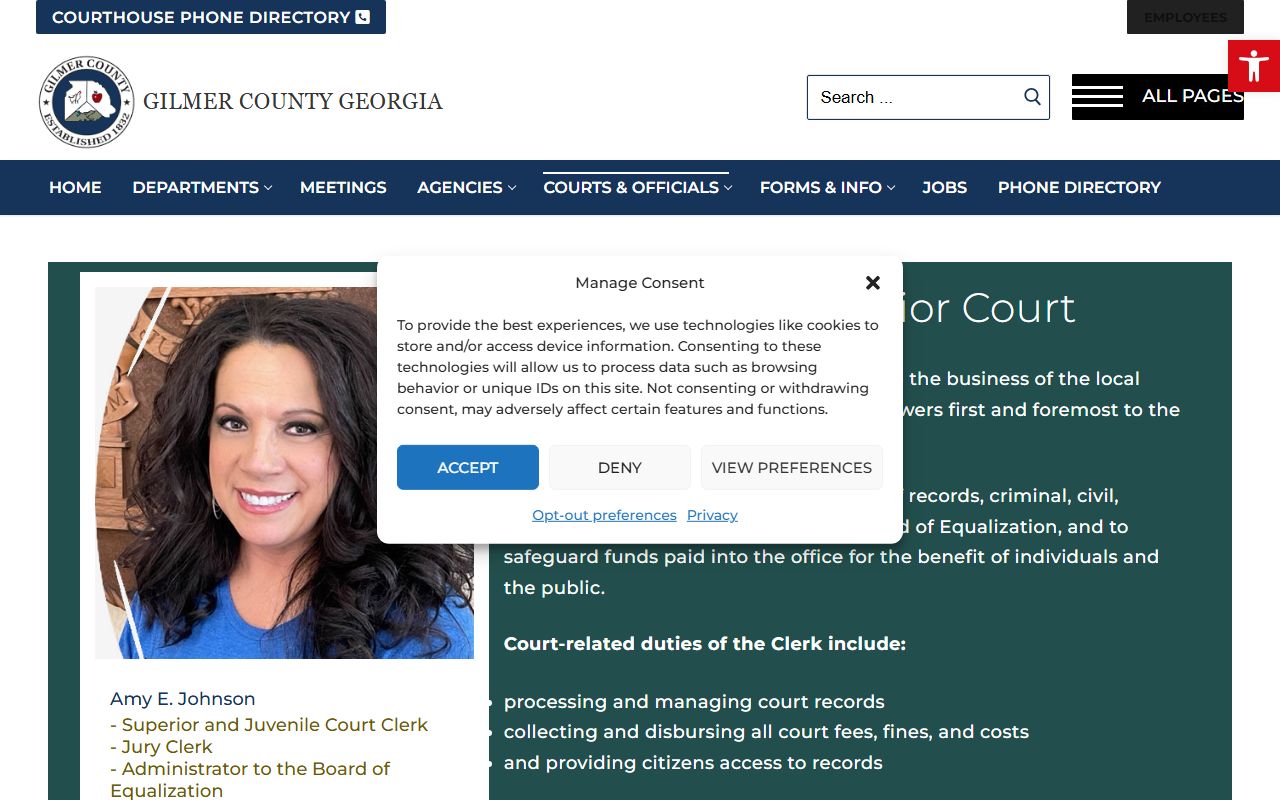
The clerk page is important because jail staff can confirm custody, but the clerk is the court-file custodian for Superior Court records.
Gilmer County Court Contacts
Use the clerk for neutral court-copy access and the District Attorney for prosecution or victim-witness context. The DA is not the neutral custodian for court copies. The Appalachian Judicial Circuit covers Fannin, Gilmer, and Pickens, and the current DA page identifies Frank H. Wood as District Attorney.
Clerk of Superior Court
1 Broad Street, Suite 203
Ellijay, GA 30540
706-635-4462
Email listed in research: amy.Johnson@gsccca.org.
Appalachian Judicial Circuit District Attorney
1 West Side Square
Ellijay, GA 30540
706-635-5381
Fax: 706-635-6303.
Charging Documents After Arrest
The booking charge is a custody clue. The court charge is the allegation as filed and tracked in court. Georgia criminal cases can use different charging documents depending on the court, charge level, and procedural stage. The research identifies indictment and accusation or information as important terms, and it frames the court record as the place where filed charges, pleas, orders, amendments, dismissals, and dispositions belong.
| Document | Who Files or Issues It | What It Means for the Case |
|---|---|---|
| Complaint | Officer, prosecutor, or court process depending on charge path | Starts or supports the allegation at an early court stage. |
| Accusation / Information | Prosecutor | Formal prosecutor-filed charge document used in some Georgia cases. |
| Indictment | Grand jury | Formal charging document commonly tied to serious felony prosecution. |
Gilmer Charge Status Terms
Charges can change after a jail arrest. A booking row may show the arresting agency's starting allegation, while the prosecutor may file different charges after review. A court may later amend, reduce, dismiss, or dispose of those charges. The charge status is one reason a court record should be checked instead of relying on a jail roster alone.
| Status | Meaning |
|---|---|
| Pending | The charge or case is not finally resolved. |
| Amended | The prosecutor or court changed the charge wording, level, or count. |
| Reduced | The charge was lowered to a less serious offense. |
| Dismissed | The court or prosecutor ended the charge without a conviction on that charge. |
| Nolle prosequi | The prosecutor declined to proceed. |
| Conviction | Guilt was adjudicated or a guilty plea was entered. |
| Bound over | A lower court sent the matter to a higher court. |
Bond After Gilmer Arrest
The Gilmer inmate handbook says bond can be made at any time, day or night, if the person is charged with a bondable offense. Bond is a surety posted as a good-faith promise that the person will appear in court. Failure to appear normally leads to re-arrest on a bench warrant with no bond, and the bondsman or person who posted security may be accountable for the full bond amount.
| Bond Type | Gilmer Handbook Detail |
|---|---|
| Cash bond or cash fine | Often used for minor traffic, misdemeanor, and civil matters; court coordination may be needed if it substitutes for appearance. |
| Property bond | Requires deeded real property in Gilmer County, ownership proof, ID, tax receipt, and original deed. |
| Professional bonding company | Licensed companies registered with the Sheriff's Office may post surety for a nonrefundable fee. |
| No-bond or bench warrant | Failure to appear usually produces a bench warrant with no bond. |
Warrants Before Court Records
The sheriff Court Services Division serves criminal warrants and civil process, provides courtroom security, and transports prisoners to and from court, correctional facilities, and medical appointments. Captain Howard Ensley commands Court Services, and the research lists 706-515-2658 for that division. No official public online active-warrant list was located, so a searchable Gilmer warrant database should not be assumed.
Once a warrant is served and a person is booked, the roster may show warrant number, statute, description, offense type, court, arrest date, arresting officer, and total bond. The roster is not a complete warrant database. If a warrant is tied to a court case, contact the court or clerk. If the person is already in jail, call the detention center to confirm any hold or no-bond status.
Charges vs Convictions
Being arrested and charged is not the same as being convicted. A Gilmer County court record after a jail arrest may show allegations that are later amended, dismissed, or resolved in a plea or verdict. A background-check decision should not be based on a roster charge alone, and official court disposition should be checked before treating a charge as final.
| Point | Charge | Conviction |
|---|---|---|
| Stage | Allegation after arrest or prosecutor filing. | Final guilt finding or guilty plea. |
| Where it appears | Jail roster and court filing. | Court disposition and criminal-history record. |
| Can change? | Yes, it may be amended, reduced, or dismissed. | Changes only through appeal, restriction, pardon, or other legal process. |
Restricted Gilmer Arrest Records
Georgia record restriction is governed by O.C.G.A. 35-3-37. It is the main Georgia path for eligible no-conviction or dismissed arrests. Restriction is not the same as proving the record never existed, and it does not guarantee that every non-government mention disappears. Juvenile, sealed, expunged, restricted, and ongoing-investigation records can have access limits.
| Issue | Sealed or Restricted | Expunged |
|---|---|---|
| Public access | Public viewing is limited under the applicable Georgia rule. | The record is removed or treated under a stronger clearing process where available. |
| Who may still see it | Some law-enforcement or court users may retain lawful access. | Access depends on the specific statute and order. |
| Georgia term | Georgia commonly uses record restriction language. | Readers often say expungement, but the state process should be checked by statute. |
Georgia Court Access Limits
The Georgia Open Records Act, O.C.G.A. 50-18-70 et seq., governs access to many public records, and the sheriff form cites that law. Court records and sheriff records still have different custodians. A book-in report request goes to the sheriff. A filed criminal case record goes to the clerk or court system. GDC offender records use GDC channels. VINELink is for notification, not a complete court-record system.
Important: This reference is not a consumer reporting agency and cannot be used for FCRA-covered employment, credit, tenant, or insurance decisions.